Bio
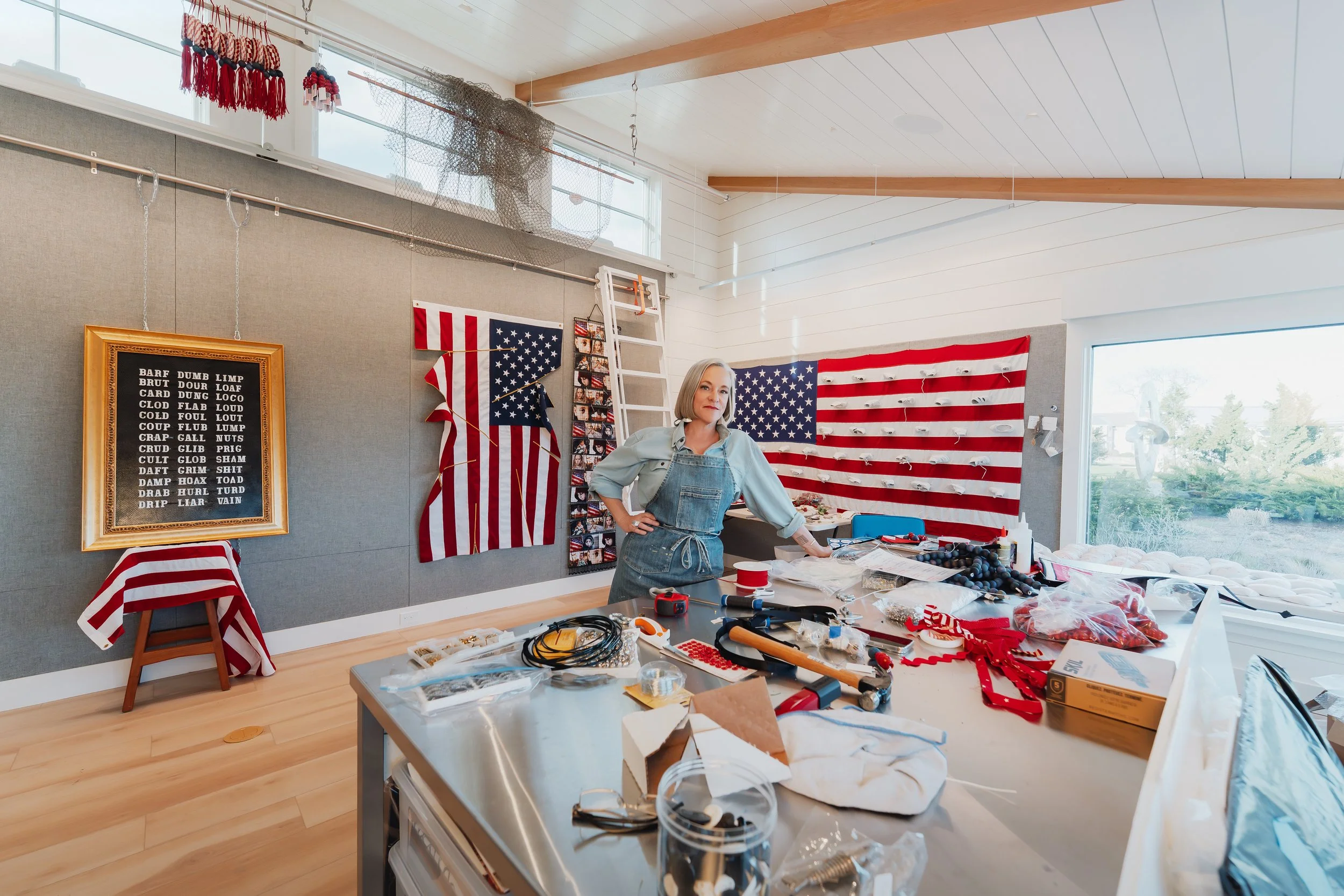
Tracy Weisman is an interdisciplinary artist and visual storyteller whose work explores identity, vulnerability, American symbolism, and the emotional tension between attachment and disillusionment. Rooted in her background as a professional speechwriter, Weisman’s practice is shaped by a deep engagement with narrative, persuasion, public language, and the ways national myths are constructed and communicated. Working across textiles, sculpture, installation, and mixed media, she often transforms familiar cultural objects through processes of stitching, alteration, accumulation, and physical disruption.
Her practice draws equally from contemporary art methodologies, craft traditions, and vernacular Americana, resulting in a body of work that resists categorization. Her work emphasizes emotional resonance and material transformation, balancing conceptual rigor with physical immediacy, and reflecting on contemporary America through both personal and collective experience. Rather than offering fixed political conclusions, the work explores emotionally charged themes by inviting viewers into a space of reflection, discomfort, contradiction, and empathy.
Weisman's current body of work and upcoming exhibition, Some Birthday, America, examines American identity and national mythology on the cusp of the country’s 250th anniversary. Her work was recently included in Unseen, a 2025 Tribeca exhibition featuring 14 international artists celebrating the resilience of North Korean women during UN Week. The exhibition introduced a global audience to her materially driven approach to social and psychological themes. Weisman has exhibited throughout the United States, and her work is included in several collections, including the private collection of a former cabinet secretary in the Obama administration and the permanent collection of Chicago Sinai Congregation
She lives and maintains studio practices in both Palm Springs, CA, and Narragansett, RI.
Artist Statement
I've always loved a good story. A lifelong communications professional and speech writer, I was always instinctively drawn to metaphors and employed them in my written work to make ideas really 'stick' with an audience.
Today as a visual artist, I'm telling my own stories. I'm intrigued by the past lives of found objects and my practice involves collecting, sorting, and manipulating materials to discover patterns and meaning, and rearranging them into works of social commentary and autobiographical themes.
By harnessing the non-verbal communication power of quotidian objects, I aim to create metaphorically and emotionally dense visual stories that reflect our shared humanity and stop viewers in their tracks.